2. Types Of Network:
3. Network Topology
a) Bus Topology
 ~A bus topology is a type of network setup where each computer and network device is connected to a single cable or backbone. connects each computer (nodes) to a single segment trunk (a communication line, typically coax cable, that is referred to as the 'bus'). The signal travels from one end of the bus to the other. A terminator is required at each to absorb the signal so as it does not reflect back across the bus. A media access method called CSMA/MA is used to handle the collision that occur when two signals placed on the wire at the same time. The bus topology is passive. In other words, the computers on the bus simply 'listen' for a signal; they are not responsible for moving the signal along.
b) Star Topology
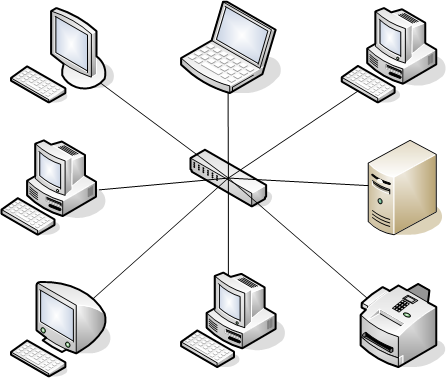
~A star topology is one of the most common network setup where each of the devices and computers on a network connect to a central hub. A major disadvantage of this network topology is that if the central hub fails, all computers connected to that hub would be disconnected.
c) Ring Topology

~A ring topology is a computer network configuration where each network computer and device are connected to each other forming a large circle (or similar shape). Each packet is sent around the ring until it reaches its final destination. Today, the ring topology is seldom used.
References / Sources:

